Why bi-layer tablets fail, and what stops them
Bi-layer construction solves incompatibility and staged release. It also introduces three failure modes that a single-layer tablet cannot have.
- Published
- 2 min read
- Subject
- Formulation
A bi-layer tablet is two formulations compressed into one dose. It solves problems nothing else solves — and it can fail in ways a single-layer tablet cannot.
Why anyone builds one
Two reasons, and they are worth separating. Chemical incompatibility: two actives that degrade in contact with each other can be kept apart in the same tablet. Staged release: an immediate-release layer over a sustained-release layer gives an onset and a maintenance dose in one unit — which is most of the modern anti-diabetic fixed-dose combinations, and a good deal of cardiovascular therapy.
The three failure modes
Delamination. The layers separate, at the interface, usually during coating or packing rather than on the press. It is a bonding problem: insufficient pre-compression on the first layer, or too much — an over-compacted first layer has no porosity left for the second to key into.
Cross-contamination between layers. The whole point was to keep the actives apart. Fine powder from the first layer carried into the second hopper undoes it, and it does not show up in a routine assay because both actives are meant to be there.
Weight variation per layer. A tablet can be within specification on total weight and out on layer ratio. That is a dissolution failure waiting for a stability pull, and it is invisible to any test that weighs the whole tablet.
What stops them
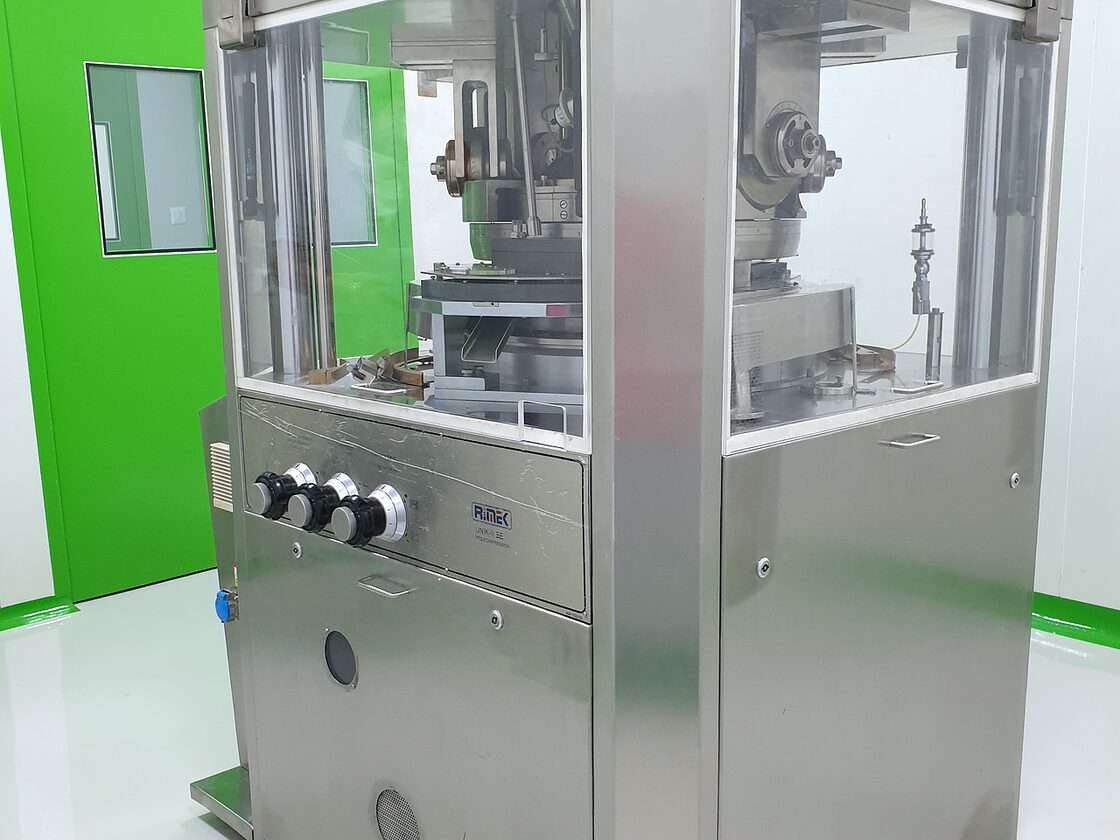
Pre-compression, principally — a controlled first compaction that gives the interface something to bond to without closing the surface. A force feeder, so the second layer's blend arrives at a consistent density rather than in flow-dependent slugs. Individual layer weight monitoring rather than total weight alone. And dust extraction at the first station, which is the unglamorous half of the cross-contamination answer.
Our compression is equipped for all of this, and it is why bi-layer sits in the modified-release group on the partnering page rather than in the general list. It is a capability, not a setting.
Read next